Payment orchestration guide › Foundations
What is payment orchestration?
Payment orchestration explained without the sales pitch: what it is, how one payment moves through it, how it differs from a gateway or a vault, and whether you need it at all.
Published:
·
17 min read

Payment orchestration is one of those terms that sounds as if it needs a consultant. It doesn’t. It’s software that sits between your business and your payment providers and decides what happens to each payment.
You connect to it once. It holds the connections to your providers, picks one for each payment, retries or reroutes when something fails, and gives you one view of what happened across all of them. The money never passes through it. Your providers still handle that.
It’s also sold far harder than most businesses need. If you run on a single provider and your approval rates are healthy, you can probably close this tab and get on with your day. If you juggle several providers, sell across borders, or can point to a month when declines or an outage cost you real money, read on.
A declaration of interest before we go further. OpenByte sells a billing and payments platform with orchestration built in. We’d rather tell you that now than have you spot it later. So treat this as the guide we’d want if we were the ones buying. Where the evidence is solid, we’ll show it. Where it’s thin, we’ll say so.
The short version
What it is: a layer above your payment providers that applies your rules to every payment.
What it does: routing, retries and failover, card storage that works across providers, one view of reporting, and hooks for fraud and authentication tools.
What it isn’t: a processor, a gateway, a fraud model or a guarantee of higher approval rates.
Who it suits: businesses that already use, or want to use, more than one provider and can put a number on what failed payments cost them.
Payment orchestration definition, in plain English
Payment orchestration is a software layer that connects a business to several payment providers through a single integration. For every payment, the payment orchestration layer chooses a provider, applies your rules for retries and failover, stores card details in a form any provider can use, and brings the reporting into one place.
That’s the working definition. The providers behind it might be payment service providers (PSPs), gateways, acquirers, wallets and bank-transfer schemes, or fraud tools. The layer treats them as parts you can swap. What changes is who’s in charge: your rules decide how payments behave, rather than whichever provider you happened to sign with first.
There’s no formal standard, so vendors draw the boundary wherever it suits their product. Some bundle orchestration with their own processing, a card vault or billing. Before you compare platforms, ask each one which of the jobs below it does itself and which it leaves to you. Some of the answers will surprise you.
What a payment orchestration layer does
Function | What it means in practice |
|---|---|
One integration | Your code talks to one API. The layer holds the connection to each provider. |
Routing rules | Choose a provider by payment method, card type, currency, country, cost or past performance. |
Retries and failover | Send a failed authorisation to another provider, or try again later, by rules you set. |
Credential vault and tokens | Store card details once, in a form that works with any connected provider. |
Reconciliation and reporting | See every attempt, outcome and settlement across all providers in one place. |
Fraud and authentication hooks | Put fraud tools and 3D Secure into the flow in whatever order you choose. |
How payment orchestration works: one payment, step by step
Definitions only get you so far. The quickest way to understand orchestration is to follow a single payment through it and watch where the layer earns its keep.
The illustration shows a $49.00 renewal that the first provider declines and the second approves. The steps below tell the same story in more detail. They follow Primer’s documented fallback behaviour. Every platform names its statuses differently, so read it as a typical sequence.
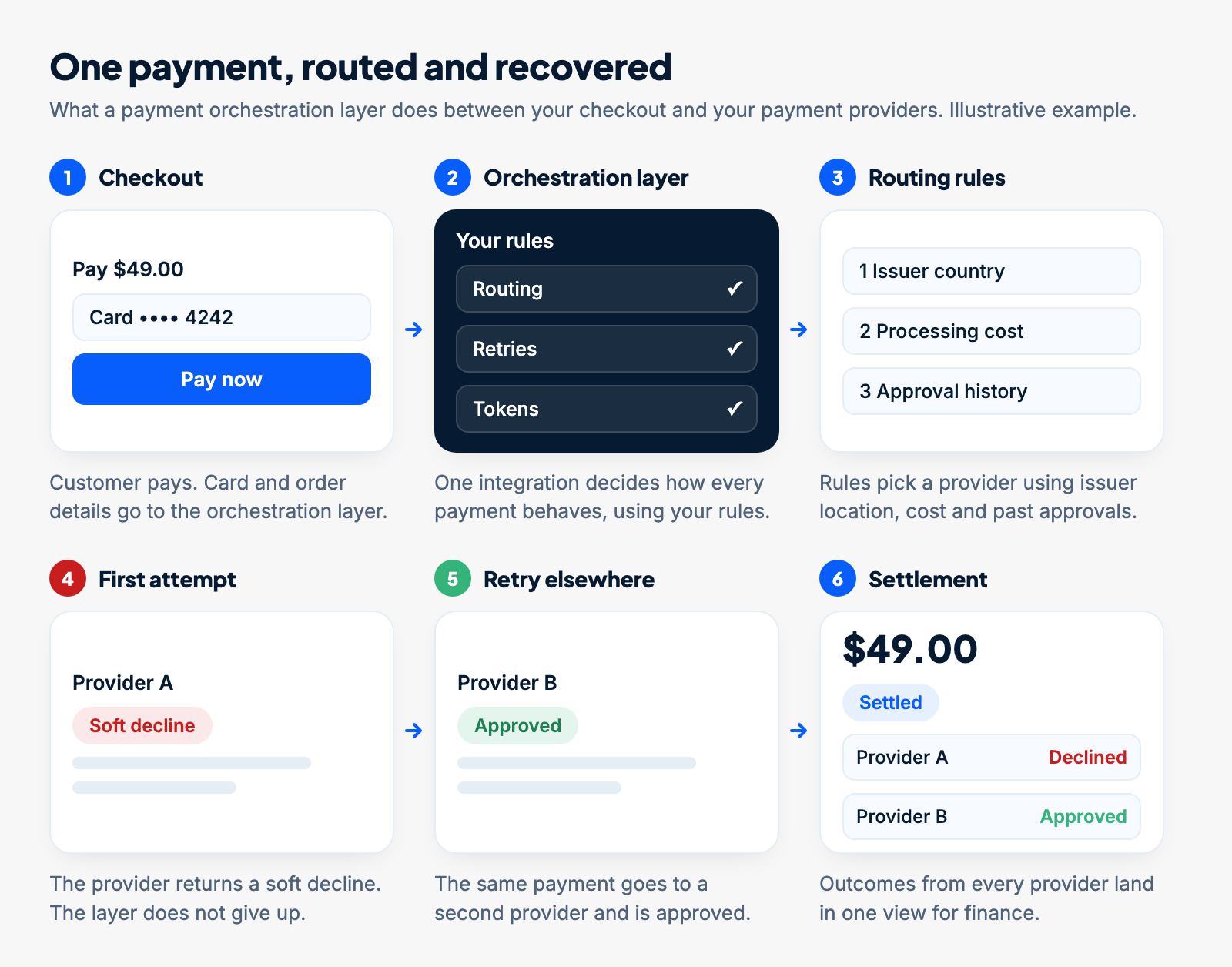
Checkout. The customer enters their card. The details go to the layer’s vault, which hands back a token. Your own systems only ever hold the token.
Payment created. Your application creates a payment against the layer, and a workflow starts.
Routing decision. The workflow picks a primary provider using your rules, perhaps by currency, card type or country. Recurly, for instance, matches the gateway to the payment method, card type and currency.
First authorisation. The layer swaps the token for card data or a network token and sends the request to the primary provider. That provider passes it on through its acquirer and the card network to the bank that issued the card.
A soft decline comes back. In Primer’s setup, a fallback can be triggered by a gateway rejection, an application error, or a soft decline from the issuer with a reason such as “do not honour” or “issuer temporarily unavailable”.
The layer decides. It checks the decline against your fallback rule. Hard declines, such as a card reported lost or stolen, stop here. Stripe won’t retry those either, and nor should you.
Second authorisation. The layer sends the payment to the fallback provider. If the customer was authenticated at checkout, that data can sometimes be reused so they aren’t challenged twice. With Primer, that holds for its own 3D Secure but not for 3D Secure run by the processor.
Outcome recorded. You see one payment with two attempts, and why the first one failed.
Reporting. Attempt-level data builds up success rates by provider, so over time you learn which provider does best with which kind of payment.
One caution about step 7. A second attempt is a second authorisation on the card networks, which cap how often you can retry the same card before fees apply. Those caps changed in 2025, and plenty of guides still quote the old ones. See numbers to ignore below.
Where the payment orchestration layer sits in the payment stack
In a simple setup, your checkout talks straight to one provider. That provider talks to its acquirer, the acquirer to the card network, and the network to the issuer. Orchestration adds one hop near the top.
From top to bottom, the stack looks like this:
Your application, checkout or billing system.
The payment orchestration layer: one API, one token.
Two or more PSPs, gateways or alternative payment method providers.
Their acquirers. Some PSPs act as their own acquirer.
The card networks, such as Visa and Mastercard.
The issuer, which approves or declines.
That extra hop is what gives you choice, and it’s also what you pay for that choice. The layer becomes a dependency in its own right, with its own uptime, its own roadmap and its own bill. Anyone selling you orchestration should be happy to talk about that. Be wary of those who aren’t.
We look at each layer, and who’s responsible for what, in where payment orchestration sits in the payment stack.
What payment orchestration is not
The term gets stretched to cover almost anything with “payments” and “platform” in the pitch deck. So it’s worth being blunt about what it doesn’t do.
It is not a… | Why |
|---|---|
Payment processor or PSP | It sits above your providers. It doesn’t process payments or replace your acquiring relationships. |
Payment gateway | A gateway carries payment data to a processor. Orchestration manages many such connections and the rules between them. |
Fraud tool | It plugs fraud tools into the flow and decides their order. It isn’t the model that scores the risk. |
Magic approval engine | It can’t make an issuer approve a payment it has good reason to decline, and it doesn’t abolish outages or fees. |
Way out of PCI | It doesn’t remove your PCI DSS obligations, though it may change their shape. Agree your scope with a qualified assessor. |
Billing software | Billing sets prices, raises invoices and manages entitlements. Orchestration takes over once a payment attempt is made. |
Payment orchestration vs payment gateway, PSP, payfac and token vault
This is where most of the confusion lives, partly because vendors use these words to mean whatever flatters their product. The table gives the most common meaning of each term. If you’re comparing payment gateway vs payment orchestration specifically, the first and last rows are the ones to read.
Term | What it is | What it doesn’t do |
|---|---|---|
Payment gateway | The front-end link that securely carries payment data from your site or app to the processor or acquirer, and brings back an approval or decline. | Route across many providers by your rules. It usually has one connection. |
Payment processor | The back-end service that authorises payments and moves funds between issuer, acquirer and networks. | Give you the merchant-facing integration. |
Acquirer | The bank or institution that lets you accept cards and settles the money to you. | Choose between providers or manage your integration. It’s one stop on the route. |
PSP | An umbrella term for a provider that bundles gateway and processing, and may connect to acquirers or act as one. | Coordinate several providers. Orchestration sits across them. |
Payment facilitator (payfac) | A PSP that signs merchants up as sub-merchants under its own master account. | Replace an orchestration layer. You often can’t hold your own acquiring relationship. |
Token vault | A secure store that maps real card numbers to tokens, so your other systems only see tokens. | Route or retry payments. A vault tied to one processor limits your ability to move. |
Orchestration layer | Coordinates all of the above with rules, retries and reporting. | Replace the providers it coordinates. |
Payment orchestration or vault?
People search for “payment orchestration or vault” as if they had to choose one. They’re different layers doing different jobs. A vault decides where card numbers live and how you refer to them. Orchestration decides which provider handles a payment and what happens when it fails.
What links them is portability. A token issued by one PSP generally only works with that PSP. Present it to another gateway and you’ll usually get an error. That sounds like a technicality until the day you want to switch providers and discover that your stored cards can’t come with you.
A provider-neutral vault, often part of an orchestration product, gets round this by issuing tokens that work at several providers. Network tokens, issued by Visa, Mastercard and the other schemes, are a separate thing again. They belong to the card rather than the provider, which is why they matter so much for failover.
Our view. Own your tokenisation. If a provider holds your stored cards in a form only it can use, you’re locked in, whatever the contract says about notice periods. It’s a trap that subscription businesses tend to find at the worst possible moment: halfway through a migration, or in the middle of an outage.
So the useful question is whether your stored cards can move. A standalone vault, an orchestration layer with one built in, or neither can all be the right answer, as long as the cards are yours to take with you. If your billing platform holds your cards, our comparison of Recurly alternatives shows what that means for renewals.
If you’re weighing orchestration against what you already have, payment orchestration vs alternatives sets the options side by side.
Subscription payment orchestration: what it means for SaaS and subscription businesses
Subscriptions raise the stakes. A one-off payment that fails is one lost sale. A renewal that fails is a customer who may quietly drift away, and the card will be tried again every billing period, possibly after it has expired. That’s why payment orchestration for SaaS and subscription businesses looks rather different from orchestration for a one-off checkout.
Picture a subscription business that renews 20,000 customers on the first of each month, all on one provider. If that provider has a bad morning, every one of those renewals queues up behind it. That’s the scenario orchestration is built for, but only if your stored cards can actually move to another provider.
Piece | How it works | What it means for orchestration |
|---|---|---|
Card on file | Adyen stores card details with the customer’s consent and charges later with a token. By default, those tokens work with one merchant account. | A PSP token ties your renewals to that PSP. |
Gateway tokens vs network tokens | Gateway tokens are tied to one gateway. Network tokens aren’t, which is what makes failover and moving subscriptions between gateways possible. Recurly says plainly that a payment method held only as a gateway token can’t fail over. | Failing renewals over to another provider needs a neutral or network token. |
Account updater | Refreshes expired or replaced card details through the card schemes. Recurly notes it doesn’t work for cards held only as gateway tokens. | Scattering credentials across providers can leave gaps in coverage. |
Retries | For new accounts, Stripe’s Smart Retries default is up to 8 retries within 2 weeks. A custom schedule allows up to 3. Hard declines aren’t retried. | Retrying the same card later is one kind of retry. Orchestration adds the other: a different route now. |
Cascading payment methods | Zuora can retry a failed payment with the customer’s other payment methods, in priority order. In November 2026 it was still an Early Adopter feature. | Another way of giving a payment a second chance. |
Renewal routing | In Recurly, a backup gateway applies to the signup transaction only, not to renewals created through its API. | Renewals are stickier than one-off payments, so failover is more constrained. |
There are two kinds of retry, and teams mix them up all the time. One tries the same card later, which is a question of timing. The other tries a different route straight away, which is what orchestration adds. A good recovery strategy needs both, and they shouldn’t be fighting each other.
The first kind belongs to dunning: the billing-side mix of emails, grace periods and card updates. Our guide to dunning management covers it, and so does the SaaS dunning strategy playbook. Failed payments also feed straight into churn, and our guide to subscription churn rate shows by how much.
What the evidence says
Now for the part our industry would rather skip. Nobody has independently measured how much orchestration improves approval rates. There’s no peer-reviewed study and no neutral benchmark. What exists is a handful of vendor case studies, each about a single merchant.
They’re still worth reading, as long as you read them for what they are. Each tells you something happened at one company. None tells you what will happen at yours.
Claim | Source | Caveat |
|---|---|---|
Baby Bunting: 2.8% higher authorisation rate within four months of moving to two acquirers with failover | One merchant. Baseline and method not stated. | |
PlayHQ: 6.9% increase in approvals | One merchant. The gain is credited to adding Mastercard Click to Pay, so it says little about routing. | |
Mattilda: 60% lower payment costs | One merchant. Unclear what the figure is based on. | |
Banxa: over US$7 million recovered in the first half of 2024 using fallbacks | One merchant. “Recovered” isn’t defined. |
Market-size figures deserve the same caution. Grand View Research’s August 2026 edition puts the payment orchestration platform market at about $2.6 billion in 2025, growing 24.7% a year to $15.5 billion by 2033. Its own earlier estimates, and other firms’ figures, differ widely, because each defines the market differently. If you quote one, quote the range.
It’s also worth looking at how “recovered revenue” gets counted. Stripe’s worked example takes 100 approved payments of $50, assumes a 20% chance that its feature caused each approval, and arrives at $1,000. Stripe is clear that this is an estimate. Many recovery figures are built the same way: modelled, then quoted as though measured.
Our view. Treat every uplift number with suspicion, ours included. The only figure that matters is what failed payments and downtime cost you today. If a vendor can’t help you work that out, their headline percentage is just decoration.
For the business case, including the parts that are hard to put a number on, see the benefits and ROI of payment orchestration.
Do you need payment orchestration?
Probably not, if you run on one provider in one market and your declines don’t keep anyone awake. Quite possibly, if you use two or more providers, sell across several countries or payment methods, and can put a number on what declines and downtime cost you.
Use these as questions to discuss with your team. None of them is a pass mark.
Question | If yes | If no |
|---|---|---|
Do you use, or plan to use, two or more providers? | Orchestration has something to coordinate. | With a single provider, it has far less to do. |
Do you sell in several countries or with several payment methods? | Routing by market and method can make a real difference. | The extra layer may not earn its keep. |
Can you put a number on what declines and downtime cost you? | You can judge whether it pays. | It’s hard to justify the cost. |
Do soft declines at one provider lose you sales you could win elsewhere? | A second route could help. | Retries on their own may be enough. |
Is payment infrastructure someone’s actual job? | Someone owns the rules and keeps them sharp. | The rules drift, and the layer becomes extra work. |
If your payments already perform well and you can’t describe a failure you’re trying to prevent, orchestration is more likely to add problems than solve them. That’s a perfectly good outcome. Spend the budget on something that’s actually broken.
You’ll see some vendors quote a monthly volume above which orchestration “pays off”. We’ve looked, and we can’t find a source for any of them. Volume alone wouldn’t tell you much anyway. A business processing $50 million a year with one reliable provider has less to gain than a smaller one losing a tenth of its renewals to soft declines.
Our view. Start with the cost of your own declines, before you book a single demo. If the number’s small, put your effort elsewhere. Who needs payment orchestration? goes through the decision in more detail.
Risks and trade-offs
Every layer you add to a payment flow is one more thing that can break at 2am on renewal day. Orchestration is no exception, and it brings a few problems of its own.
A new dependency. The layer can go down, and you’re relying on its uptime and its roadmap as well as your providers’.
More complexity. Every routing rule is something to test, monitor and keep up to date. Rules nobody owns become rules nobody understands.
Scattered data. If reporting isn’t properly consolidated, more providers can mean less visibility.
Migration effort. Moving stored cards and integrations is real work, and token portability is usually the hardest part.
Good declines stay declined. An issuer that says no for a sound reason will say no to your second provider too.
Risks and common misconceptions of payment orchestration takes each of these further.
How to choose a payment orchestration platform
If you’ve done the sums and orchestration looks worthwhile, these are the questions we’d put to any platform, ourselves included.
Which providers, payment methods and markets does it support today, as opposed to on the roadmap?
How much engineering effort does the integration really take?
How flexible are the routing rules, and can you see why each payment went where it did?
If you leave, do your tokens and stored cards leave with you?
What do you get for reporting and reconciliation, and will your finance team actually use it?
How reliable and secure is it, and who’s accountable when the layer itself has an incident?
Does it handle subscription renewals, network tokens and account updates, or only one-off payments?
That last question rules out more platforms than you might expect. Our guide on how to choose a payment orchestration platform goes into more detail. If you’d like to see how we’ve approached it for subscription businesses, our payment orchestration page explains.
Numbers to ignore
Some statistics turn up on vendor page after vendor page, usually without a source. We’ve tried to trace them. Where we couldn’t, we don’t use them, and we’d suggest you don’t rely on them either.
Retry limits with no date attached. The card networks do cap retries, and the caps move. Visa raised its limit for declines the issuer can’t approve right now from 15 to 20 in 30 days in May 2025, then raised its excess-retry fees in April 2026. Many guides still say 15. Mastercard’s thresholds are 10 in 24 hours or 35 in 30 days. Undated figure? Ask your acquirer.
“Orchestration pays off above $400,000 a month”. We can’t find where it comes from, and it’s not clear whether it means volume, revenue or losses.
Approval uplifts of “2 to 3%”, “2 to 10%”, “10 to 30%” and “up to 15%”. They contradict each other. The “up to 15%” figure traces back to a 2011 paper on e-commerce payment integration, which isn’t about orchestration at all.
“Failover in milliseconds” and “99.99% uptime” presented as industry benchmarks. They’re design targets, and you should ask how they’re measured.
“60 to 70% of declines are recoverable” and similar claims put down to unnamed “industry data”.
Claims that orchestration cuts PCI scope by a set percentage. Your scope depends on your setup and your assessor.
The rest of the payment orchestration guide
This article is the starting point. The rest of the guide goes deeper on each question, and you can read the parts in any order.
Foundations: The problems payment orchestration solves and Where payment orchestration sits in the payment stack
Capabilities: Core capabilities of payment orchestration, Why payment retries fail at scale and Payment processor failover architecture
Fit and relevance: Who needs payment orchestration? and Payment orchestration vs alternatives
Outcomes: The benefits and ROI of payment orchestration and Risks and common misconceptions of payment orchestration
Implementation: How to choose a payment orchestration platform
Frequently asked questions
What is payment orchestration in simple terms?
It’s software that sits between your business and your payment providers. You integrate with it once, and it decides which provider handles each payment and what happens if that provider fails.
How does payment orchestration work?
The customer’s card is stored as a token. The layer applies your routing rules, picks a provider and sends the authorisation. If the provider soft declines, the layer can retry or send the payment to another provider. It records every attempt and brings the reporting into one place.
What does payment orchestration platform mean?
A payment orchestration platform is the product that provides the orchestration layer: a single API, connections to many payment providers, a token vault, routing and retry rules, and consolidated reporting. Some platforms also include their own processing or billing, so check what each one actually covers.
What is the difference between payment orchestration and a payment gateway?
A gateway carries payment data to a processor, usually through one connection. Orchestration sits above gateways and PSPs and coordinates several of them, with rules for routing, retries and reporting. Many orchestration platforms use gateways underneath.
Is payment orchestration the same as a payment service provider?
No. A PSP processes your payments. Orchestration coordinates one or more PSPs and doesn’t replace any of them.
Can orchestration improve approval rates?
In some setups, yes absolutely, for instance when a soft-declined payment gets a second route. But nobody has independently measured how big the effect is, and an issuer that declines for a good reason will decline again.
What is the difference between payment orchestration and a token vault?
A vault stores card details as tokens. Orchestration decides which provider handles a payment. A provider-neutral vault, often part of an orchestration product, lets one token work across several providers.
Does orchestration work for subscriptions and renewals?
Yes, with limits. Failing a renewal over to another provider needs a token that works at both, such as a network token. Some billing systems also restrict backup gateways to the first signup payment.
What are the downsides of payment orchestration?
A new dependency, extra complexity, possible gaps in reporting and the effort of migrating. It also doesn’t absolutely prevent outages or turn legitimate declines into approvals.
Key takeaways
Payment orchestration is a layer above your providers that applies your rules to each payment. It coordinates them, and it never holds the money itself.
A typical payment is tokenised, routed by your rules, retried or rerouted after a soft decline, and reported on across every provider in one place.
It isn’t a gateway, a processor, a fraud model or a guarantee of approvals, and it doesn’t make your PCI obligations disappear.
Own your tokenisation. Renewals depend on stored cards, and cards locked to one provider are where lock-in hides.
The public evidence is vendor case studies about single merchants. Judge orchestration on what failed payments and downtime cost you, whatever the headline figures say.
If you’re weighing this up, try a simple exercise first. Pull a month of your declines and split them into soft and hard. Then estimate what share of the soft ones a second provider might have won back.
That number will tell you more than any benchmark, ours included. If it looks worth chasing, have a look at our payment orchestration page and see whether it fits the way you bill.
More in this part of the guide

The problems payment orchestration solves
The operational and technical issues orchestration is designed to fix

Where payment orchestration sits in the payment stack
Understanding how orchestration fits alongside billing, PSPs and gateways
Explore the full payment orchestration guide →

