
Recurly vs. OpenByte
The Recurly alternative for high-volume subscription businesses.
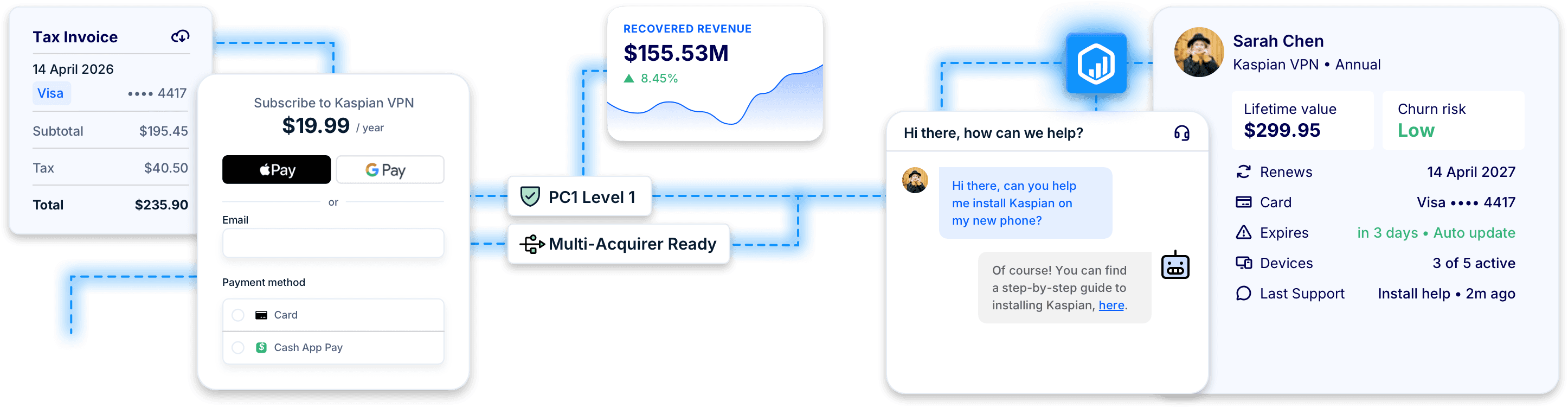
If you’re comparing Recurly alternatives, the deciding question is usually what sits around billing: payments, support, marketing and customer data. OpenByte puts all of them in one system for high-volume subscription brands, so a failed payment, a support ticket and a win-back offer all work from the same customer record.







Feature
OpenByte
Billing
Subscription billing
Yes
Yes
Usage-based billing
Yes
Yes
Metered billing
Yes
Yes
Entitlement management
Yes
Yes
Invoicing and bill runs
Yes
Yes
No-code plan setup
Yes
Yes
Multi-currency
Yes
Yes
Payments
Multi-gateway support
Yes
Yes
Intelligent payment routing
Increase payment acceptance rates at scale to protect revenue.
Yes
Partial
Failed payment retries (ML)
Yes
Yes
Card-on-file updater
Yes
Yes
Fraud intelligence
Stop fraudulent payments without declining good customers, so you protect revenue and avoid chargebacks.
Yes
Yes
Smart dunning
Yes
Yes
Cancel-flow offers
Yes
Yes
Churn-risk flagging
Yes
Yes
Customer operations
Built-in support desk
Resolve billing issues where the invoice lives, so problems are fixed faster and fewer customers churn.
Yes
No
AI-assisted support
Answer billing questions instantly and at scale, so customers stay instead of cancelling.
Yes
No
Marketing automation
Reach customers with the right offer at the right moment to grow retention and expansion revenue.
Yes
No
Unified customer record
One view of every customer across billing, support and marketing, so teams act on the full picture to protect revenue.
Yes
Partial
Event-triggered campaigns
Turn a billing event, such as a failed payment, into an instant message that recovers revenue before it is lost.
Yes
No
Cross-functional churn workflows
Connect billing, support and marketing in one churn response, so at-risk revenue is saved faster.
Yes
No
Revenue and reporting
Consolidated reporting
One set of numbers across billing, payments and support, so finance can trust the revenue figures.
Yes
Partial
Cross-system analytics
See how support, marketing and payments activity affect revenue, not just billing data on its own.
Yes
No
Platform
Merchant of Record
No
Partial
API access
Yes
Yes
PCI DSS Level 1
Yes
Yes
KEY DIFFERENCES
When OpenByte is the right Recurly alternative.
1. Billing platform or customer operations platform.
Recurly is a subscription management platform. It covers plan setup, recurring charges, dunning, analytics and revenue recognition. Customer support, email marketing and a single customer record sit outside it: Recurly connects to tools such as Zendesk, Salesforce and Braze through integrations instead.
OpenByte brings those into one system. Support agents see billing history on every ticket, campaigns trigger from real billing events, and finance reports from one set of numbers.
Why that matters.
Every extra system is another place a failed payment or cancellation has to be pieced back together. With one customer record, the same event reaches the right team straight away, which helps recover renewals sooner and makes billing queries quicker to resolve.
OpenByte
One platform for billing, payments, support, marketing and customer data, with one customer record across all of them.
VS
Recurly
Specialist subscription billing and payments. Support, marketing and customer data live in other tools, connected by integrations.
2. Payment failover that covers renewals.
Recurly connects to 40+ payment gateways, with custom routing rules, account updaters and Intelligent Retries, its machine-learning retry engine. Its automatic Gateway Failover switches new payments to a backup gateway when errors spike, but recurring transactions are paused during a failover event and sent to the primary gateway once it recovers. The feature isn’t included in the Starter or Pro plans.
Recurly’s documentation is also clear that when only a gateway token is stored, failover to another provider isn’t possible. Renewals are most of a subscription business’s revenue, so OpenByte’s payment orchestration is built to reroute them too, with routing and retries that draw on the whole customer record. Our guide to payment gateway failover explains why stored cards are the hard part.
Why that matters.
A paused renewal is a delayed renewal, and a long outage on renewal day pushes a lot of revenue into a queue. Rerouting renewals to a healthy provider keeps that money moving, provided your stored cards can be charged there.
OpenByte
Payment orchestration that can reroute renewals as well as new payments, informed by the full customer record.
VS
Recurly
40+ gateways, routing rules and Intelligent Retries. Automatic failover pauses renewals until the primary gateway recovers, and isn’t on Starter or Pro.
3. Churn recovery that sees the whole customer.
Both platforms retry failed payments, update expired cards and offer cancel flows. In Recurly’s case, cancel save flows come with Recurly Engage, which is priced separately. The difference is the information behind those decisions.
Recurly’s recovery works from billing data, plus whatever Engage receives from connected tools. OpenByte’s draws on billing, support and marketing together, so a failed payment from a long-standing customer with an open support ticket can be handled differently from one on a brand-new account.
Why that matters.
Involuntary churn is revenue lost without the customer deciding to leave. Recovery that knows the customer’s history can win back more of it, and avoids treating a loyal customer like a stranger.
OpenByte
Retries, card updating and cancel flows informed by billing, support and marketing history. A failed payment can trigger a support task or a tailored offer.
VS
Recurly
Intelligent Retries and account updaters, with cancel save flows through Recurly Engage (priced separately).
4. Pricing as you scale.
Recurly’s Starter plan is $249 a month plus 0.9% of billing volume, with the first $40K of monthly billings included. All-Access is under 1% of billing volume with a $1M minimum and annual billing, and it’s the plan that adds multiple dunning campaigns, multicurrency and custom reporting. Engage and RevRec are extra.
OpenByte’s pricing is based on your scale and scope. Because it replaces separate support, marketing and reporting tools, compare it with the full stack around Recurly, not Recurly’s line alone.
Why that matters.
Percentage-of-revenue pricing grows as you do. Model the total cost at the volume you expect to reach next year, including the tools you’d run alongside your billing platform.
OpenByte
Custom pricing based on scale and scope, replacing several tools.
VS
Recurly
Starter $249 a month plus 0.9%. All-Access under 1% with a $1M minimum. Engage from $1,600 and RevRec from $850 a month.
WHY OPENBYTE
Why teams choose OpenByte over Recurly.
Where one connected platform for payments, billing, support and marketing makes the biggest difference.
Your renewals can’t wait for a gateway to recover.
Recurly’s automatic Gateway Failover pauses recurring transactions until the primary gateway recovers, and isn’t included in the Starter or Pro plans. OpenByte’s payment orchestration can reroute renewals to a second provider, so renewal day doesn’t stall when one gateway struggles.
Billing questions land on your support team every day.
OpenByte’s AI-assisted support desk shows payment history, entitlements and account status on every ticket, with no integration to build or maintain. Recurly has no help desk of its own, so agents work in a separate tool from the billing data.
You want churn recovery that knows the customer.
Retries, card updates, cancel flows and win-back campaigns all work from one record in OpenByte, so a loyal customer with an open ticket is treated differently from a brand-new account. With Recurly, cancel save flows come with Recurly Engage, priced separately.
You run consumer subscriptions at serious volume.
OpenByte is built for high-volume subscription apps, from antivirus to wellness, and manages 350M+ customer records. At that scale a fraction of a point on renewal rate or contact rate is real money, and that’s what the platform is built to move.
PRICING
Recurly pricing.
Recurly’s Starter plan costs $249 a month plus 0.9% of billing volume, with the first $40K of monthly billings included. The All-Access plan is under 1% of billing volume, billed annually, with a $1M billing volume minimum, according to Recurly’s pricing page (checked 11 November 2026).
Recurly Engage (cancel flows and subscriber messaging) starts at $1,600 a month and Recurly RevRec (revenue recognition) at $850 a month, both billed annually. Multiple dunning campaigns, multicurrency, single sign-on and custom reporting are listed under All-Access, so Starter customers get a more limited set. Because the fee is a share of billing volume, Recurly’s cost grows with your revenue.
OpenByte’s pricing is based on your scale and scope. Because it replaces separate support, marketing, customer data and reporting tools, compare it with the full stack around Recurly, not Recurly’s line alone.
WHEN IT FITS
Recurly
might
be right for you if…
Recurly is a good choice for plenty of subscription businesses. It’s probably the better fit if:
You want to change plans and pricing without developers.
Recurly lets teams launch and change plans “without a ticket or an engineering sprint”, and adds an AI co-pilot, Compass, for configuring the platform. If you iterate on pricing often, that’s a real advantage.
You’re happy with your existing support and marketing tools.
If your help desk and email platform work well and you don’t want to consolidate, Recurly slots in as the billing layer and connects to tools like Zendesk and Salesforce. OpenByte can run alongside existing tools too, but its biggest gains come from one customer record.
You sell subscriptions through Shopify.
Recurly has a dedicated All-Access for Shopify plan, and in 2025 it acquired the Shopify-first subscription platform Prive, now Recurly Commerce. If Shopify is the centre of your business, that focus is hard to beat.
Other Recurly alternatives to consider
Recurly’s main competitors each suit a different kind of business. If OpenByte isn’t the right fit, these are the Recurly alternatives we’d look at next, and who each one suits:
Chargebee: the closest like-for-like billing alternative, strong on self-serve SaaS. Chargebee alternative
Zuora: built for complex, enterprise quote-to-cash. Zuora alternative
Paddle: a Merchant of Record that handles global sales tax for you. Paddle alternative
Stripe Billing: the natural choice if you already process everything through Stripe. Stripe Billing alternative
See also: How Recurly compares to Chargebee
SWITCHING
Switching from Recurly?
Moving from Recurly means migrating subscriptions, customer records, entitlements and, most importantly, stored payment details. Cards held only as gateway tokens can’t simply be charged by a new provider, so the migration plan starts with how your card data moves. OpenByte’s onboarding team handles the data mapping, a period of parallel running and testing, and plans the cut-over around your renewal calendar.
FAQ
Frequently asked questions.
What is the best Recurly alternative?
Who are the main Recurly competitors?
How much does Recurly cost?
Can I migrate from Recurly to OpenByte?
Why do companies switch from Recurly?
Does Recurly handle customer support?
Is Recurly good for high-volume D2C subscriptions?
Does either platform act as a Merchant of Record?
What's the difference between Recurly and OpenByte for enterprise subscriptions?
About this comparison: all information about Recurly comes from recurly.com and Recurly’s own documentation, checked on 11 November 2026. Features, plans and pricing change, so check Recurly’s website for the latest details. Recurly is a trademark of its owner, and OpenByte isn’t affiliated with or endorsed by Recurly. Spotted something out of date? Let us know and we’ll correct it.

