
Chargebee vs. OpenByte
The Chargebee alternative for high-volume subscription businesses.
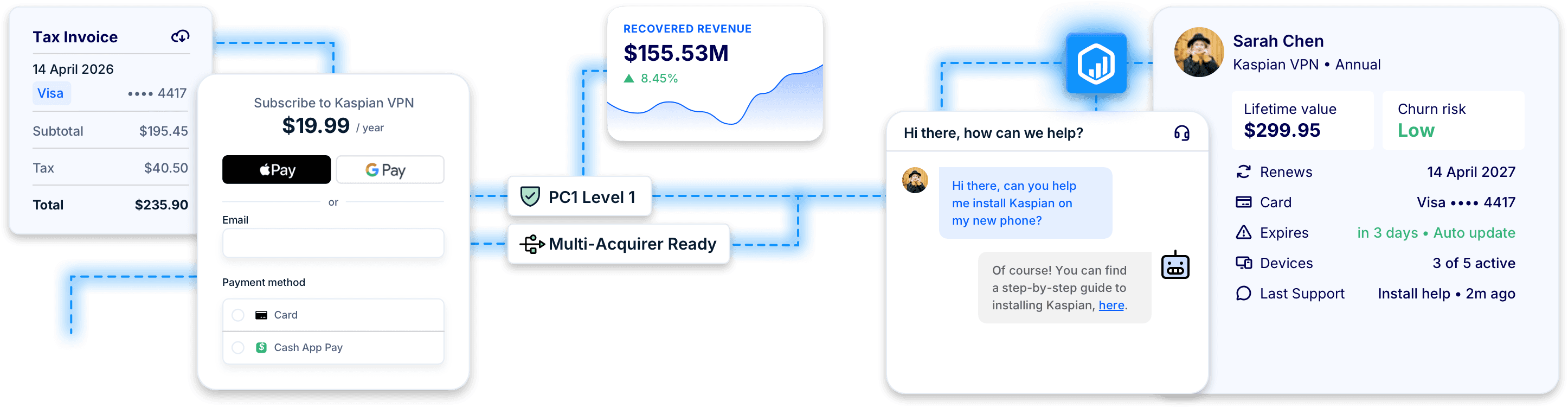
If you’re comparing Chargebee alternatives, the deciding question is usually what sits around billing: payments, support, marketing and customer data. OpenByte puts them all in one system, so a failed renewal, a support ticket and a win-back offer work from the same customer record.







Feature
OpenByte
Billing
Subscription billing
Yes
Yes
Usage-based billing
Yes
Yes
Metered billing
Yes
Yes
Entitlement management
Yes
Yes
Invoicing and bill runs
Yes
Yes
Price books / pricing experiments
Partial
Yes
Payments
Multi-gateway support
Yes
Yes
Intelligent payment routing
Increase payment acceptance rates at scale to protect revenue.
Yes
Partial
Failed payment retries (ML)
Yes
Partial
Fraud intelligence
Stop fraudulent payments without declining good customers, so you protect revenue and avoid chargebacks.
Yes
Partial
Customer operations
Built-in support desk
Resolve billing issues where the invoice lives, so problems are fixed faster and fewer customers churn.
Yes
No
AI-assisted support
Answer billing questions instantly and at scale, so customers stay instead of cancelling.
Yes
No
Marketing automation
Reach customers with the right offer at the right moment to grow retention and expansion revenue.
Yes
No
Unified customer record
One view of every customer across billing, support and marketing, so teams act on the full picture to protect revenue.
Yes
Partial
Event-triggered campaigns
Turn a billing event, such as a failed payment, into an instant message that recovers revenue before it is lost.
Yes
No
Revenue and reporting
Consolidated reporting
One set of numbers across billing, payments and support, so finance can trust the revenue figures.
Yes
Partial
Cross-system analytics
See how support, marketing and payments activity affect revenue, not just billing data on its own.
Yes
No
Platform
CPQ (configure, price, quote)
No
Yes
Merchant of Record
No
Partial
API access
Yes
Yes
PCI DSS Level 1
Yes
Yes
KEY DIFFERENCES
When OpenByte is the right Chargebee alternative.
1. Billing platform or customer operations platform.
Chargebee is a billing and revenue platform covering subscriptions, invoicing, usage billing, dunning and revenue recognition. Customer support and lifecycle marketing sit outside it: Chargebee connects to help desks such as Zendesk, Freshdesk and Intercom through integrations, and to HubSpot and Klaviyo for marketing.
OpenByte brings those into one system. Support agents see billing history on every ticket, campaigns trigger from real billing events, and finance reports from one set of numbers.
Why that matters.
Every extra system is another place a failed payment or cancellation has to be pieced back together. With one customer record, the same event reaches the right team straight away, which helps recover renewals sooner and makes billing queries quicker to resolve.
OpenByte
One platform for billing, payments, support, marketing and customer data, with one customer record across all of them.
VS
Chargebee
Specialist billing, usage and revenue tools. Support, marketing and customer data live in other tools, connected by integrations.
2. Payment routing and renewal failover.
Chargebee connects to 40+ payment gateways. Its Smart Routing assigns each payment method and currency to a gateway, and its documentation says you can’t have multiple gateways for the same currency and payment method combination. When a renewal fails, the documented fallback is the customer’s backup payment method.
Smart Dunning is included on both plans, and Revive, Chargebee’s machine-learning retry engine, supports Stripe and Braintree today. OpenByte’s payment orchestration is built to reroute renewals to a second provider, with retries informed by the whole customer record. Our guide to payment gateway failover explains why stored cards are the hard part.
Why that matters.
Renewals are most of a subscription business’s revenue. If your gateway has a bad morning on renewal day and there’s no second route for that card and currency, those renewals wait or fail. A second provider that can charge your stored cards keeps them moving.
OpenByte
Payment orchestration that can reroute renewals to another provider, with retries informed by the full customer record.
VS
Chargebee
40+ gateways, with Smart Routing by payment method and currency. ML retries (Revive) on Stripe and Braintree, and rules-based Smart Dunning.
3. Where each platform goes deepest.
Chargebee serves a broad range of businesses, from B2B SaaS and generative AI to digital media and consumer memberships. Its deepest tooling is for sales-led and usage-based billing: CPQ inside Salesforce and HubSpot, high-volume usage ingestion, and contract terms and multi-entity management on its Enterprise plan.
OpenByte is built for high-volume consumer subscription businesses, from antivirus to wellness apps, where millions of renewals, tickets and cancellations a month make cost to serve the number that matters.
Why that matters.
At millions of customers, small percentages become large numbers. A fraction of a point on renewal rate or contact rate is worth real revenue or real headcount. At that volume a platform is judged on cost to serve, renewal rate and net revenue retention, and the length of its feature list matters much less.
OpenByte
Built for high-volume D2C subscription apps (antivirus, wellness, health) scaling to millions of customers. 350M+ customer records managed.
VS
Chargebee
Broad fit from startups to enterprise, deepest for B2B SaaS, AI and usage-based billing, with CPQ and multi-entity support.
4. Support and retention on one customer record.
When a customer contacts support about a billing problem, the agent needs payment history, entitlements and account status. With Chargebee, that data reaches your help desk through an integration. Cancel flows come from Chargebee Retention, part of the separately priced Chargebee Growth product, which has a free Starter tier.
In OpenByte, support, retention offers and billing share one data layer, so the agent and the cancel flow both see the whole customer.
Why that matters.
Contact rate, handle time and first-contact resolution decide what support costs per customer. When agents see billing history, entitlements and payment status inside the ticket, they spend less time switching tools and asking customers to repeat themselves. That lifts first-contact resolution and brings handle time down.
OpenByte
AI-assisted support desk and cancel flows with full billing, payment and entitlement context. No integration required.
VS
Chargebee
No built-in help desk. Connects to Zendesk, Freshdesk and Intercom. Cancel flows through Chargebee Retention, priced separately.
WHY OPENBYTE
Why teams choose OpenByte over Chargebee.
Where one connected platform for payments, billing, support and marketing makes the biggest difference.
Your renewals need a second route.
Chargebee’s documentation allows one gateway per currency and payment method, and a failed renewal falls back to the customer’s backup payment method. OpenByte’s payment orchestration can reroute renewals to a second provider, so a bad morning at one gateway doesn’t become a bad month.
Billing questions land on your support team every day.
OpenByte’s AI-assisted support desk shows payment history, entitlements and account status on every ticket, with no integration to build or maintain. Chargebee has no help desk of its own, so agents work in a separate tool from the billing data.
You want churn recovery that knows the customer.
Retries, card updates, cancel flows and win-back campaigns all work from one record in OpenByte, so a loyal customer with an open ticket is treated differently from a brand-new account. With Chargebee, cancel flows come from the separately priced Chargebee Growth.
You run consumer subscriptions at serious volume.
OpenByte is built for high-volume subscription apps, from antivirus to wellness, and manages 350M+ customer records. At that scale a fraction of a point on renewal rate or contact rate is real money, and that’s what the platform is built to move.
PRICING
Chargebee pricing.
Chargebee Billing’s Flow plan is priced on monthly invoicing volume: either $0 plus 0.80%, or $99 a month plus 0.65%, according to Chargebee’s pricing page (checked 11 November 2026). On our maths, the second option is cheaper above about $66K of monthly invoicing. Enterprise pricing is by demo and quote.
Several things cost extra. Chargebee CPQ, RevRec and HubSpot sync are priced separately, and the Salesforce, NetSuite and Avalara integrations, enterprise access controls and data exports to your warehouse are paid add-ons on Enterprise only. Because the fee is a share of invoicing volume, Chargebee’s cost grows with your revenue.
OpenByte’s pricing is based on your scale and scope. Because it replaces separate support, marketing, customer data and reporting tools, compare it with the full stack around Chargebee, not Chargebee’s line alone.
WHEN IT FITS
Chargebee
might
be right for you if…
Chargebee is a good choice for plenty of subscription businesses. It’s probably the better fit if:
You need CPQ for a sales-led team.
If your sales team builds multi-product quotes with approvals, Chargebee CPQ runs inside Salesforce and HubSpot, and CPQ Lite includes the first 50 quotes free. OpenByte doesn’t offer CPQ.
You bill on usage, credits or AI tokens.
Chargebee’s Flow plan includes 100M usage events a month, with tiered, volume and stairstep pricing, and Chargebee markets dedicated billing for AI agents. If usage pricing is the hardest part of your billing, that depth matters.
You’re happy with your existing support and marketing tools.
If your help desk and email platform work well, Chargebee connects to Zendesk, Freshdesk, Intercom, HubSpot and Klaviyo and slots in as the billing layer. OpenByte can run alongside existing tools too, but its biggest gains come from one customer record.
Other Chargebee alternatives to consider
Chargebee’s main competitors each suit a different kind of business. If OpenByte isn’t the right fit, these are the Chargebee alternatives we’d look at next, and who each one suits:
Recurly: the closest like-for-like billing alternative, with plan changes that don’t need developers. Recurly alternative
Zuora: built for complex, enterprise quote-to-cash. Zuora alternative
Paddle: a Merchant of Record that handles global sales tax for you. Paddle alternative
Stripe Billing: the natural choice if you already process everything through Stripe. Stripe Billing alternative
See also: How Chargebee compares to Recurly | How Chargebee compares to Zuora | How Chargebee compares to Stripe Billing
SWITCHING
Switching from Chargebee?
Moving from Chargebee means migrating subscriptions, customer records, entitlements and, above all, stored payment details. Cards held as gateway tokens can’t simply be charged by a new provider, so the migration plan starts with how your card data moves. OpenByte’s onboarding team handles the data mapping, parallel running and testing, and plans the cut-over around your renewal calendar.
FAQ
Frequently asked questions.
What are the best Chargebee alternatives?
Who are the main Chargebee competitors?
Is Chargebee a payment processor?
How much does Chargebee cost?
Can I migrate from Chargebee to OpenByte?
Why do companies switch from Chargebee?
Does Chargebee handle customer support?
What's the difference between Chargebee and OpenByte for D2C subscription businesses?
Does either platform act as a Merchant of Record?
About this comparison: all information about Chargebee comes from chargebee.com and Chargebee’s own documentation, checked on 11 November 2026. Features, plans and pricing change, so check Chargebee’s website for the latest details. Chargebee is a trademark of its owner, and OpenByte isn’t affiliated with or endorsed by Chargebee. Spotted something out of date? Let us know and we’ll correct it.

